Peace Corps
Cat PersonThe Peace Corps is the institutional frame for Aaron’s volunteer service in Butula, but the account offers no broad portrait of the organization. Instead, it shows it through the narrow, consequential points at which it touches his life: training before or around his work, a school-provided home, complaints to supervisors, and the procedure for leaving. That limited view makes the organization significant less as an abstract mission than as the structure Aaron must rely on when his confidence in his work and his sense of safety begin to fail.
Role in Aaron’s service
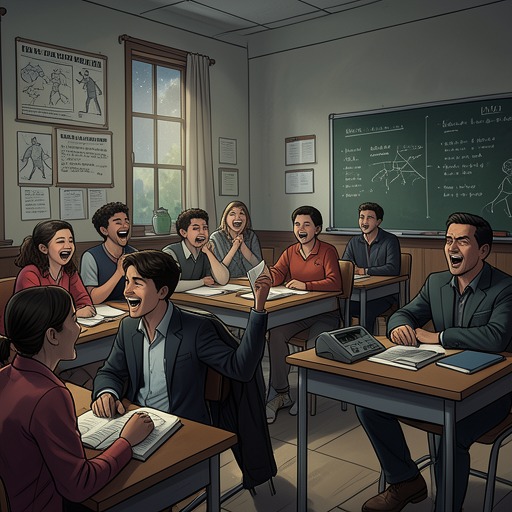
Aaron is a Peace Corps volunteer assigned to teach the first-middle-school class at Butula Girls’ School. The assignment places him in a setting where the adults around him anticipate difficulty: the school’s teachers have accumulated stories about the girls’ disruptive behavior, and one teacher responds to Aaron’s request for advice with resignation rather than practical guidance. This is the immediate working environment in which the volunteer role takes shape. The account does not detail Aaron’s formal duties or the Peace Corps’ aims; it shows instead the distance between the institutional fact of his assignment and the unpredictable demands he faces in the village and classroom.
The school, rather than the Peace Corps, provides Aaron’s house. He has complained to his Peace Corps supervisors about the accommodation from his first day, suggesting that the organization is a point of contact for problems with his living conditions even though it does not supply the house itself. This distinction matters: the service arrangement places Aaron in a school-provided home, while the supervisors remain the people he can approach when the arrangement becomes part of his dissatisfaction with the assignment.
Training and its limits
Aaron has mentioned eight weeks of Peace Corps training after his arrival in Butula. Grace treats this fact as evidence of a much more extensive education than he actually describes. In her imagination, he has spent months in a classroom learning every detail of Kenyan life, from how to greet an elder to how to cut a mango. She is consequently surprised by his mistakes and sometimes seems to blame his imaginary instructors for failing to prepare him. Her expectation is comic in its exaggeration, but it also reveals a real tension in the story: the presence of training can be mistaken for comprehensive local knowledge.
The account does not establish what the training covered or whether it was adequate by any formal standard. What it does establish is the gap between Grace’s expansive idea of what Aaron must have been taught and his experience of not knowing what he needs to know. The recurring question about whether the Peace Corps school taught him about night runners makes that gap personal and memorable. Grace treats the custom as familiar local knowledge; Aaron’s training, as he understands it, has not equipped him with that understanding. The contrast is not proof that the organization promised mastery of local life, but it shows how the volunteer’s institutional preparation is measured against expectations it cannot satisfy in every encounter.
Supervision, housing, and support
Aaron’s relationship with the organization is also marked by a complaint that predates his decision to leave. From the outset, he has objected to the house supplied by the school and has raised the matter with Peace Corps supervisors. The account gives concrete reasons for his discontent: the house is small and badly maintained, and he encounters evidence of bats inside it. These details make the accommodation more than a passing inconvenience; it is part of the daily setting in which he is trying to carry out his assignment. Yet the account does not describe a change in his housing or a specific response to his earlier complaints.
When Aaron later contacts his supervisor, he says that he has been harassed in the village, feels he has nothing left to offer the community, and wants to return home. He expects an attempt to persuade him to stay or reassure him that his work matters. Instead, the supervisor asks whether he feels in danger or is considering harming himself. Aaron says no. She then tells him to come to the office the following day to complete resignation paperwork. The exchange gives the supervisor’s response a clear, procedural shape: she checks immediate safety, then explains how he can leave. It does not describe further counseling, a discussion of alternatives, or an effort to resolve the circumstances that led him to call.
Resignation and narrative significance
Aaron is struck by how quickly the resignation becomes possible. He had expected resistance; instead, once he says he wants to go, the process seems to move through an already functioning administrative system. His sense that the Peace Corps has left him practically alone sits beside this efficiency. The organization can facilitate departure promptly, even as the story has shown the difficulty of his work and living situation without showing a comparable intervention that makes remaining sustainable.
The decision to resign does not immediately sever Aaron’s attachment to the people and place he is leaving. On his final day, he walks into town, buys a chapati and a Coca-Cola for himself, then buys a second chapati and Coca-Cola for Grace. He wonders how she will react to his departure and recalls her challenge about what his training should have taught him. That small purchase places the institutional exit beside a personal goodbye: the paperwork belongs to the Peace Corps, while his thoughts remain with Grace and the unlearned knowledge she represents.
The Peace Corps therefore functions in the narrative as both a service framework and a limit. It assigns Aaron, provides training, connects him with a supervisor, and offers a route to resignation; the account does not establish that it caused the difficulties he encounters or that it could have prevented them. Its significance lies in the contrast between formal procedures and lived uncertainty. Aaron’s departure is administratively straightforward, but the story leaves the deeper question of what preparation and support could have enabled him to stay unanswered.